Evaluating Mediterranean Citrus Tile Digital Paper for Creative Projects
Selecting the right digital assets for a design project often requires balancing aesthetic appeal with technical functionality. For designers, crafters, and small business owners working within the warm, sun-drenched aesthetic of Southern Europe, Mediterranean Citrus Tile Digital Paper has emerged as a specific and popular resource. This asset category is not merely a background image; it represents a stylistic choice that evokes the coastal vibes of Italy, Greece, and Spain through the motif of lemons, oranges, and traditional tiling. Understanding what distinguishes this specific type of digital paper from generic patterns or other vintage collections is essential for making an informed decision about its suitability for your next endeavor.
Defining the Aesthetic and Technical Composition
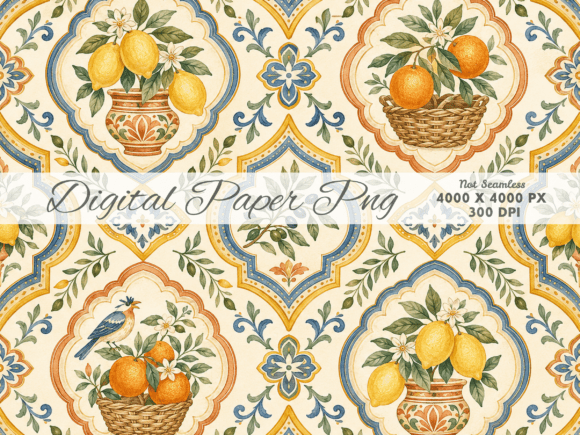
At its core, Mediterranean Citrus Tile Digital Paper combines two distinct visual languages: the organic shapes of citrus fruits and the geometric rigor of traditional tile work. Unlike free-hand illustrations or watercolor washes that might drift across a page, this style relies on structure. The "tile" aspect implies a grid-based or repeating architectural element, often mimicking the hand-painted ceramics found in Amalfi Coast kitchens or Portuguese courtyards. When paired with vintage lemon imagery, the result is a pattern that feels both historic and fresh.
The specific iteration known as the Vintage Lemon Collection typically emphasizes a muted, aged palette. Rather than the neon brightness of modern vector graphics, these designs utilize cream, ochre, sage green, and terracotta tones to simulate the look of aged paper or weathered stone. Technically, these files are usually delivered as high-resolution PNGs. It is crucial to note that many of these specific tiles are designed as standalone motifs rather than seamless, infinite patterns. This distinction significantly impacts how they are used. A seamless pattern can be stretched indefinitely without visible breaks, whereas a non-seamless tile is intended to be placed strategically, perhaps as a border, a focal point on an invitation, or a contained element within a larger layout.
Comparative Analysis: Tiles vs. Seamless Patterns
When evaluating digital paper options, one of the most critical decision factors is the difference between a tiled motif and a seamless pattern. Many users initially assume all digital papers function identically, leading to frustration when a file does not repeat perfectly. Mediterranean Citrus Tile Digital Paper often falls into the category of distinct, high-detail compositions.
In comparison to seamless backgrounds, which are ideal for covering large surfaces like website backgrounds or fabric rolls, tile-based designs offer greater compositional control. They allow the creator to dictate exactly where the lemon motif appears relative to the text or other design elements. For example, in scrapbooking, a seamless pattern might overwhelm a photograph, whereas a single, crisp tile can frame a memory without dominating the page. However, the trade-off is evident in scalability. If a project requires wrapping a large box or creating a full-wall mural, a non-seamless tile would require significant manual editing to create a cohesive look, whereas a seamless pattern would handle this automatically. Therefore, the choice depends largely on the scale and intent of the final output.
Format Considerations: PNG vs. Vector Alternatives
Another vital comparison lies in the file format. The standard delivery for these citrus tiles is often a high-resolution PNG. This raster format is universally compatible with almost all design software, from professional suites like Adobe Photoshop to user-friendly platforms like Canva. The advantage of a PNG, particularly one with a transparent background, is the ability to layer the tile over any color or texture instantly.
Conversely, some designers might seek vector formats (SVG or EPS) for this same aesthetic. Vectors offer infinite scalability without pixelation, which is superior for large-format signage or vinyl cutting. However, vector versions of intricate, vintage-style citrus tiles can sometimes lose the textured, "hand-painted" nuance that defines the Mediterranean look. The rasterized PNG preserves the subtle grain and color variations that give the design its vintage character. For projects like sublimation printing on mugs or creating digital invitations, the fixed resolution of a high-quality PNG is usually sufficient and often preferable for maintaining artistic integrity.
Practical Applications and Best-Fit Scenarios
The versatility of Mediterranean Citrus Tile Digital Paper makes it a strong candidate for a wide array of applications, provided the user understands its limitations. Its strengths are most apparent in projects that benefit from a defined focal point or a decorative accent.
- Stationery and Invitations: This is perhaps the ideal use case. The structured nature of the tile works beautifully for wedding invitations, brunch menus, or greeting cards. The motif can be placed in a corner or as a central medallion, leaving ample white space for typography.
- Digital Scrapbooking: For digital planners and scrapbooks, these tiles serve as excellent journaling cards or pocket fillers. The vintage lemon theme adds a cohesive seasonal touch to summer layouts without requiring complex masking or editing.
- Sublimation and Print-on-Demand: Entrepreneurs creating custom merchandise will find these designs effective for coasters, tote bags, and ceramic tiles. The high resolution ensures that the crisp details of the fruit and glaze effects remain sharp after the heat transfer process.
- Wall Art and Home Decor: When framed digitally or printed on canvas, these patterns mimic the look of actual ceramic art. They are particularly effective in gallery walls where a mix of botanical and geometric prints is desired.
However, there are scenarios where this specific product may not be the optimal choice. If the goal is to create a continuous wallpaper for a mobile device or a fabric print for upholstery, a non-seamless tile will require advanced editing skills to tile manually without visible seams. In such cases, seeking a dedicated "seamless pattern" version of a Mediterranean citrus design would be a more efficient workflow.
Decision Factors for the Modern Creator
Ultimately, choosing Mediterranean Citrus Tile Digital Paper comes down to a balance of aesthetic desire and technical requirement. For the adult creator aged 20 to 50 who values authenticity and ease of use, this asset offers a shortcut to a sophisticated, travel-inspired look. It eliminates the need to source physical vintage papers or paint complex botanical illustrations from scratch.
When evaluating whether to purchase or download a specific pack, consider the license terms carefully. Many of these digital papers are available for both personal and commercial use, which is a significant advantage for small business owners selling handmade goods. Yet, always verify if the license allows for "print-on-demand" specifically, as some creators restrict the resale of the design on certain platforms. Additionally, check the DPI (dots per inch) of the file. For screen-only use, 72 DPI is acceptable, but for any physical printing—such as greeting cards or wall art—a resolution of 300 DPI is mandatory to ensure professional quality.
In conclusion, while there are countless digital patterns available, the Vintage Lemon Collection within the Mediterranean tile niche occupies a unique space. It bridges the gap between rustic charm and clean design. By understanding the distinction between tile motifs and seamless repeats, and by matching the file format to the intended medium, creators can leverage these assets to produce work that feels both timeless and professionally curated. Whether used to elevate a simple DIY craft or to anchor a complex branding package, these digital papers provide a reliable foundation for bringing a slice of the Mediterranean coast into everyday design.